
Inclusive of the July hike of 25 paise, a monthly increase of similar amount would result in a saving of Rs 2.25 a litre for the current financial year alone.

In a move that may boost the Indian hydrocarbon industry and bring more investments into the sector, the Union Cabinet on Wednesday decided to give marketing freedom to domestic crude oil producers, allowing them to sell petroleum to any company in the local market. The move is set to be beneficial for major crude oil producers, such as state-run Oil and Natural Gas Corporation (ONGC) and Oil India, and private sector majors like Vedanta's Cairn Oil and Gas and Reliance Industries. As of May 31, India was dependent on imports for 86 per cent of its crude oil consumption; domestic production sufficed the remaining 14 per cent demand.

Ajit Mishra, vice president, Research, Religare Broking, answers your queries.
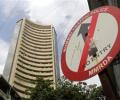
D-Street is hoping RBI policy review meeting on Tuesday will uphold its stand on easing of interest rates

Most analysts expect growth in the sales of Nifty-50 companies to decelerate, albeit marginally, in the quarter ended December compared to the corresponding period of 2013-14, with metals and real estate companies pulling down earnings.

Pawan Hans, Dredging Corp on list to meet target of Rs 800 bn for 2018-19

The companies' underrecoveries stood at a whopping Rs 1,39,869 crore last financial year. Of that, Rs 62,837 crore was accounted for by diesel alone.

There is the problem of regions in the North East being theatre for power-play by nations with borders and influences converging in those parts, which in turn requires a sizable presence of the armed forces, notes Shyam G Menon.

The UAE central bank will then make payments in dirhams to Iran.

The 30-share Sensex ended down 538 points at 26,781 and 50-share Nifty ended down 152 points at 8,067.

Sun Pharma was by far the biggest gainer in the Sensex pack, surging 8.13 per cent, followed by Dr Reddy's at 4.92 per cent.

These firms offer job security and lucrative salries.

The Union government will gain close to Rs 1.6 lakh crore in additional revenues this fiscal from a record hike in excise duty on petrol and diesel that has pushed the total incidence of taxation on auto fuels to 70 per cent of the price. Late on Tuesday evening, the government hiked excise duty on petrol by Rs 10 per litre and that on diesel by Rs 13 a litre to mop up gains arising from international oil prices falling to a two-decade low.

Centre and state governments are steadily increasing excise duties and value-added tax
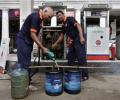
The latest round of petrol and diesel price increase, on Thursday, met with opposition from many corners.

The third-quarter financials didn't excite market watchers. But equity investors can still make money if they invest in the right stocks.

It may be the season for corporate matchmaking but India Inc's record of managing partnerships is far from impressive, says Shailesh Dobhal.

ONGC is raising debt for a spate of acquisitions over the past year

Among Sensex constituents, HCL Tech suffered the most by diving 2.26 per cent, followed by HDFC shedding 2.10 per cent.

The run-up to next year's general elections might see some of the top executives of government-run companies getting unlucky. And, the period could become the best in the lives of those waiting in the wings.

The share of public sector undertakings (PSUs) in the total market capitalisation of listed companies--at an all-time low of 10 per cent currently --- may get a leg-up from the government's divestment push. Recently the government announced the successful sale of national carrier Air India to Tata Sons, India's first privatisation of a PSU since 2002-03. The transaction is expected to be completed by December.

Processes are at an advanced stage for a number of assets of the Centre and central public sector enterprises (CPSEs) to be monetised. The assets include office space, apartments, factories, land, power transmission assets, sports stadia, gas pipelines, and telecom assets.

'We began foolishly bragging about Saudi-Emirati investment plans as indicative of the sheikhs 'distancing' from Pakistan, including on Kashmir,' notes Ambassador M K Bhadrakumar.

India has asked refiners that owe about $6.5 billion to Iran for oil imports to build up dollar and euro balances to avoid downward pressure on the rupee if six world powers and Tehran reach a final nuclear deal.

These refineries, commissioned mostly in the 1950s and 1960s during India's early industrialisation push, are inefficient and costly to maintain compared to their modern counterparts on the coast mainly operated by private companies.

A chunk of divestment till now has come from follow-on offerings in the Centre's two ETFs, Bharat-22 and CPSE. Now, there will be initial public offerings of Mazagon Docks, rail companies RVNL and IRFC and MSTC.

Markets ended in green on rate cut hope.

'The actual price of petrol is Rs 35 and it jumps to Rs 88 because of government taxes.'
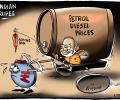
One of the major advantages of buying Iran crude is the additional credit period of 90 days that the country gives to India, compared to 30 days by other countries.

Low fuel prices to help oil marketing and refining sectors but upstream players will stay under pressure.

Diesel makes up nearly half of fuel demand in Asia's No 3 economy.

After getting Indian Oil Corporation, the nation's largest oil firm, to drop four independent directors and Engineers India Ltd to boot out two, it is now seeking to sack former Power Secretary P Uma Shankar, chartered accountant S Ravi and former BPCL Chairman R K Singh from the board of ONGC.

Analysts are enthused by BPCL's upstream foray and have re-rated the stock in the past couple of years.
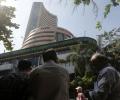
Brokers said a flurry of buying by investors in blue-chips mainly influenced the sentiment.

'The correction could take two to three months and traders need to be careful.' 'For investors, this could be a good time to nibble in.'
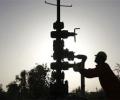
Reason behind for the change in his stance: gas price increase.

While consumer electronics, technology, mobile phones, auto and sports-wear categories dominate the top 20, FMCG has only one entry in the list

J R D Tata and Air India... Mrigank Warrier explores one of India's eternal love stories.

The government has tweaked the income tax laws to make it easier for the new owners of loss-making public sector undertakings (PSUs) to carry forward the accumulated losses and set them off against future profits. This will result in significant tax savings for the new owners if they are able to turnaround operations of the ailing PSU within a few years. This will, in turn, boost the post-tax earnings and returns for the new owners.
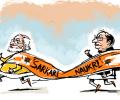
'Sachin Pilot once calculated that with a million Indians flooding the labour market every month, only an additional 12 million jobs annually could keep unemployment at the same level.' 'That's chickenfeed for the functionaries who cram my e-mail inbox every day with such a constant flow of job offers that trying to empty it is like trying to drink dry the horn connected to the ocean in Norse mythology,' says Sunanda K Datta-Ray.
